
The Price of Being a Woman
Short history of periods
Although it is a natural part of womanhood, menstruation is often stigmatized. Periods are portrayed as unhygienic, often being shunned by the mainstream media. To be comfortable during this monthly cycle, women have been making their own period products all throughout history. Before the items that we see on our shelves today sanitary products were once crafted using leather or linen-wrapped moss and sand. An early model of the polymer plastic pads we know and use today were once called menstrual belts. These cloth belts were fastened to women’s underwear to help catch the blood.
On record, the earliest design of a commercially sold and disposable pad was in 1986. This primitive model was unaffordable for most and not a commonality, as many women were too embarrassed to buy them. The modern tampon was invented in 1931, but it did not break into mainstream media and become a popular choice for women until the 1960s. As women began to prefer using a tampon over sanitary products, advertising and competition between different companies increased.
The price of periods
There has been an increase in the market, which makes the prices for these necessary products competitive. These are already pricey items to begin with but with The Tampon Tax, an EU law that meant an additional minimum 5% tax was added to period products because they were once classed by the government as a luxury item. In effect of The Tampon Tax many women struggled for years to afford these necessary products.
Thankfully, after the UK left the European Union, The Tampon Tax was swiftly abolished at the start of 2021. This was a part of a bigger action from the government to End Period Poverty. As a part of the new scheme, free period products were and continue to be supplied in schools, colleges, and hospitals. Even before The Tampon Tax was abolished, in 2015 when the extra tax was still in use, the UK government created The Tampon Tax Fund. Although they weren’t able to remove the extra tax entirely at the time, the fund meant the VAT was used to fund charities that support vulnerable women and girls. Since the fund was created, they have raised £42 million and continue to contribute donations to this day.
Short History of the Pink Tax
Have you ever gone into a shop and noticed that women's products are more expensive than men's? Even though the products are identical and have the same purpose.
The Pink Tax refers to women's products that are similar or even the same as men's, but they differ in price due to the colour, scent, or packaging. Companies will often target women when marketing certain products. Most commonly The Pink Tax is linked to women’s hygiene products. When the inequality has been highlighted in the past, companies have stated that the price difference is due to the extra production costs that occur when making feminine products. The additional colouring to make pink and purple, or floral patterns that are often used to show the customer who the product is meant for is their excuse for these outrageous extra production costs of feminine products. Women typically spend 11% more of their income on essentials because of this.
The Pink Tax at play
We can demonstrate the difference with an example of the average costs of different products, from the UK retailer Boots:
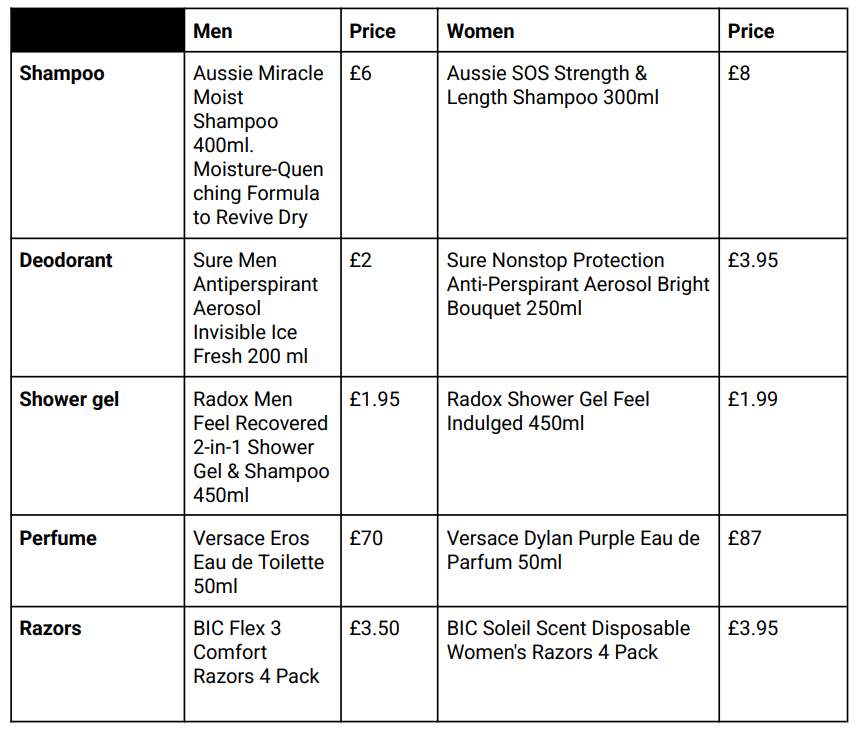
Where possible, we advise you to think about and look at the product you are taking off the shelf before purchasing. Often the men's version is a more cost effective choice. A lot of companies also hand out free sanitary products that we recommend women take advantage of as well.
